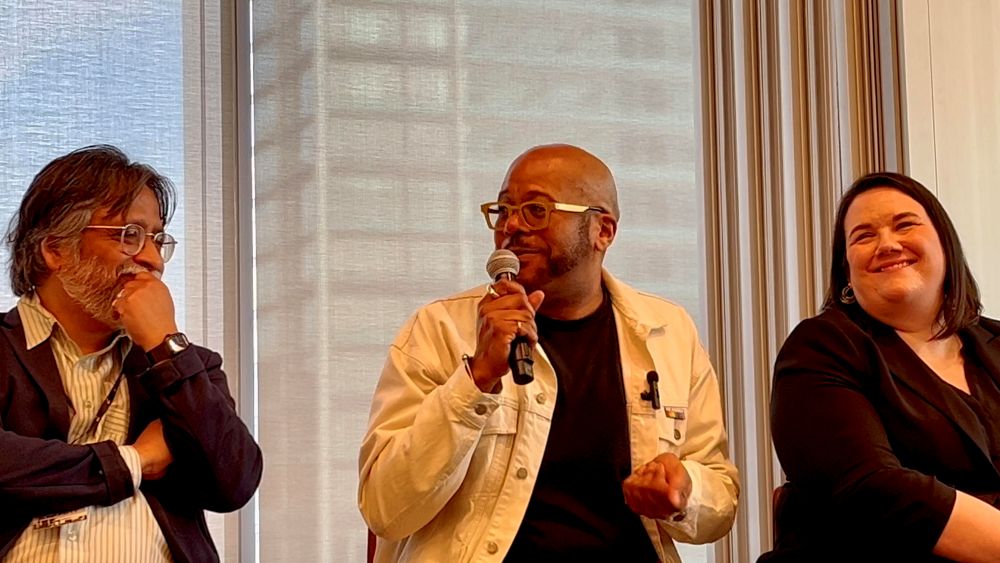
 From left: POCAM and Barrett & Welsh’s Gavin Barrett, the Breakfast Club’s Jefferson Darrell and Design de Plume’s Jennifer Taback. (Photo credit: Scott Dagostino)
Black History Month is typically framed as a period to reflect on progress, but as February unfolds, a timely question arises for the creative sector: Has the industry translated years of conversation into meaningful change among minority communities? Strategy spoke with BIPOC leaders about stalled progress and a growing reluctance to confront inequity head-on. On Wednesday, we’ll look at where pressure for change is coming from and what sustained action could look like.
Near the end of last year, the Canadian Public Relations Society (CPRS) released the 2025 State of the PR Industry survey results. To bring the findings to life, the association encouraged engagement with its AI tool SOPR-GPT, which it billed as “an interactive way to explore the data and insights behind the report. Ask questions. Compare results. See how Canadians, business leaders and professionals really feel.”
Jefferson Darrell (pictured below) took the CPRS’s advice and asked SOPR-GPT: “Is Canada’s PR and communications field truly welcoming and open to all?” Short answer: “No – not fully. While the field expresses inclusive values, the actual experience of belonging, advancement and voice remains uneven, especially for people of colour, LGBTQ2+ professionals, women and people living with disabilities.”
Further engagement with the data and SOPR-GPT found that, between 2020 and 2025, the industry talked more about inclusion than ever before and that representation increased modestly, yet equity and belonging stagnated or declined. The data suggest that progress has stalled, an issue that many members in the BIPOC creative community have been drawing attention to for years.
The results were echoed in the fifth-annual Visible & Vocal study from People of Colour in Advertising and Marketing (POCAM), which surveyed Black, Indigenous and People of Colour (BIPOC) in the creative sectors. The data showed that incidents of microaggressions and discrimination have increased to levels greater than they were prior to the murder of George Floyd in 2020.
POCAM’s survey reported that 80% of respondents experienced microaggressions, 58% experienced racial discrimination and 33% experienced racial harassment from a colleague. Additionally, 56% of those surveyed believed their employer was making positive steps to focus on inclusion and advancement of BIPOC professionals – versus 70% in 2021 – while 88% said they needed to be on guard at their agency or place of employment.

None of this is news to Darrell. He’s been on the frontlines of this fight throughout his nearly 20-year career as an award-winning marketing communicator and brand strategist.
In 2017, he founded Breakfast Culture, “a full-scale, data-driven, tech-forward diversity, equity and inclusion marketing and consulting company,” that works with organizations through its Workplace Culture Assessment Tool. In 2020, Darrell worked with CPRS, the International Association of Business Communicators (IABC) and the Canadian Council of Public Relations Firms, in collaboration with Breakfast Culture, to conduct a survey asking similar questions around equity, diversity and inclusion (EDI).
There is no shortage of studies, reports, surveys and data – often damning – but little consensus within the industry on how to turn awareness into sustained change.
In its 2025 research report, the Canadian Marketing Association (CMA), in partnership with strategy, asked nearly 500 Canadian marketers about their experience with equity, diversity and inclusion (EDI) “amid shifting global attitudes toward EDI, most notably major policy reversals in the U.S. and subsequent organizational responses to either hold firm on EDI initiatives or let them fall by the wayside.”
For the first time in its five years of research, the CMA asked marketers about whether they’ve witness pushback toward EDI initiatives over the past year and how that is playing out in organizations. According to the findings, people from marginalized communities are more likely to report seeing this pushback (64% vs. 42% among people from non-marginalized communities).
“The most cited forms of opposition are: Reluctance to allocate resources (time, money or personnel) to EDI initiatives; and: Passive opposition – such as ignoring policies or not participating in EDI training,” the CMA found.
All of this led Darrell to ask: “Why is no one in the industry talking about this injustice beyond our identifying groups?”
“I find it fascinating that … when it comes to the differences between racialized peoples, and how we’re treated in society, how women are treated in society, we can’t talk about those issues,” Darrell tells strategy.
BIPOC in Canadian advertising: The trickle-up effect
Darrell believes the cultural shift between the push for EDI initiatives in 2020 and the recent scaling back stems, in part, from cultural shifts south of the border. For instance, some 300,000 Black women were reportedly forced out of the workforce in the U.S. in 2025 because of federal layoffs and EDI cutbacks, Darrell says.
“To me, that 300,000 in the U.S. is the biggest indicator of what’s to come next” in Canada, he says. “What’s that old saying? When the states sneeze, Canada catches a cold. It just happens here a few years later … Since Donald Trump came into power in November 2024, it has now become acceptable and seeing more of this outright bigotry and discrimination when it comes to the workplace is being normalized yet again.”
Like Darrell, Gavin Barrett has been dealing with this issue before Trump 1.0, 2.0 and the EDI surge in 2020.
Barrett is the CEO, CCO and co-founder of multicultural agency Barrett and Welsh, which specializes in branding and advertising with a focus on inclusivity for racialized communities. Founded in 2003, the agency has produced award-winning work and served clients such as CIBC/Simplii, Allstate Canada, Walmart, TD Bank and others. Barrett co-founded and is a co-chair for POCAM, which in January launched a Vancouver chapter.
“I’ve seen every version of this industry as it’s evolved,” Barrett tells strategy. “When I came to Toronto in 1996, to say it was a very white industry would be an understatement, because I could literally count every single person of colour. I knew them all. So have we changed? Absolutely we’ve changed. But we’ve changed in very limited, precise ways, and that in itself is a very reflective bias.”
He agrees with Darrell that Canadians can learn from our neighbours to the south. “They’re a lot more honest about their racism,” Barrett says. “It’s not something to emulate, but we can understand because of the clarity that that open racism provides.” When it comes to racism, as with many facets of life in the U.S., he adds, there is a corresponding Canadian version, “an understated, polite way of putting you in your place, shutting you up, keeping you down.”
Additional photo courtesy of Jeff Speed.