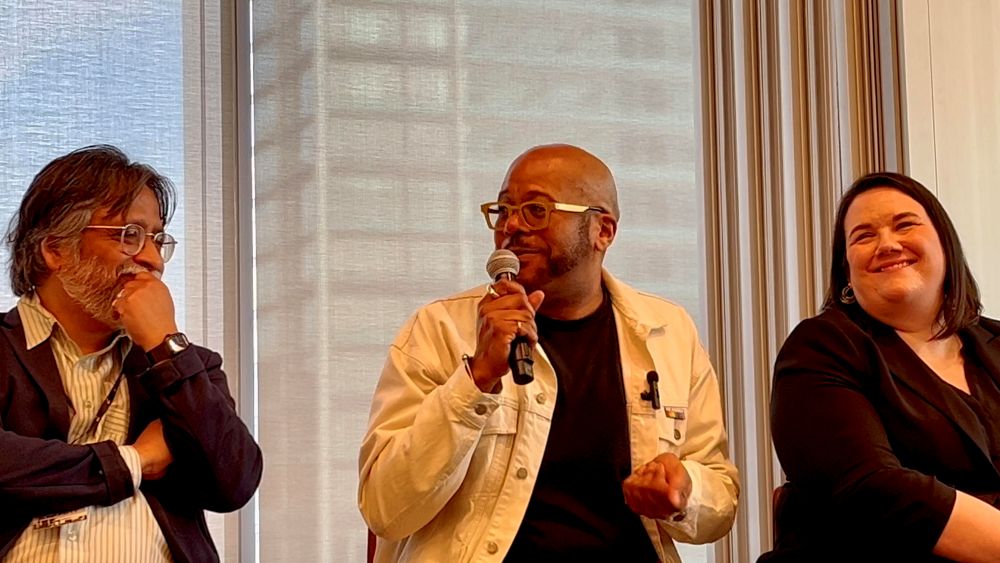
 From left: POCAM and Barrett & Welsh’s Gavin Barrett, the Breakfast Club’s Jefferson Darrell and Design de Plume’s Jennifer Taback. (Photo credit: Scott Dagostino)
Black History Month is typically framed as a period to reflect on progress, but as February unfolds, a timely question arises for the creative sector: Has the industry translated years of conversation into meaningful change among minority communities? Strategy spoke with BIPOC leaders about stalled progress and a growing reluctance to confront inequity head-on. Read Part 1 of the feature here.
If the data shows progress has stalled in support of BIPOC communities in the creative industry, the question shifts to where pressure for real change will come from. For those working in Canadian advertising and communications, the answer is increasingly clear: Incremental progress and good intentions aren’t enough, what’s required is continuing efforts from decision makers as well as those on the ground.
Change, says Gavin Barrett, a co-founder and co-chair of People of Colour in Advertising and Marketing (POCAM), will come about only through action, “consistent, committed action.”
“It doesn’t have to be loud, but it has to be sustained,” adds Barrett, who is also the CEO, CCO and co-founder of multicultural agency Barrett and Welsh.
It’s one of the reasons POCAM launched its Call for Equity Progress Tracker in 2021. According to POCAM’s website, 159 organizations signed the Call for Equity, 54 have registered for the Progress Tracker, 13 have publicly shared their commitment and annual diversity data and four have reported all commitments complete.
“Will we call out people? Yes, we will,” Barrett says. “But is that what we’re about? No. We want to celebrate success. We want to celebrate the change in the industry. We want to make that change happen, to support that change, even in small measures.”
According to Juanita Kwarteng (pictured below), diversity and inclusion manager for Publicis Groupe Canada, industry-wide change, especially after 2020, was impeded by initial EDI initiatives that were “treated as a moment instead of a mandate.”

“For there to be any resolution to something, you have to acknowledge it,” Kwarteng tells strategy. “For any type of change to become a reality, you need resources and you need long-term action. And across our industry, as well as many other industries, the commitment to DEI has really fluctuated as a result of political and various socioeconomic pressures. As a result, the momentum has also slowed down.”
Publicis Groupe Canada joined the chorus of Canadian agencies that ramped up EDI efforts in 2020, with Stephanie McRae creating a specific department that saw Kwarteng hired as program manager before she stepped into her current role as EDI manager in 2021.
Since then, Publicis’s approach has been to create programs that confront barriers to access – access to education, to the industry and to experience. One of those initiatives was a collaboration with CEE Centre for Young Black Professionals in 2023 to address the unemployment gap for Black youth in the company’s largest-ever pro bono campaign. “Who I Really Am” was the first major work for CEE, a Toronto non-profit that provides free professional workforce skills training and development for Black youth, alongside holistic supports like access to social workers and therapists, education and advocacy.
Publicis also broadened the scope of its EDI platform “This is the Job” in 2021, adding a French language version to the initiative in 2023 to expand its reach across the country, while also inking partnerships with several Canadian school boards and piloting a job fair event for students. The platform aimed to give young people who may not have considered advertising for a career the tools they need to see how their skills and interests could translate into a specific role at a Canadian agency.
And last May, Publicis and POV Film launched the Advertising Training Program, which gave 15 aspiring BIPOC creatives the chance to develop their skills and work out solutions to real-world business problems, highlighted by a pitch challenge in which they worked alongside more than 20 marketing mentors from Canadian Tire.
Kwarteng says the most effective initiatives are those that are long-term, co-created by communities and have an impact on business outcomes.
“I get the numbers, I get the sense of pessimism,” she says. “It’s important to acknowledge the reality, but also to acknowledge the things that people are doing to move this forward. And this thing, this problem, has been around for a long time. It’s not going to be resolved overnight. But the most important thing is the consistency of action.”
BIPOC in Canadian advertising: Another form of ROI
Yogi Omar (pictured right), manager of diversity, inclusion and talent development at Rethink in Vancouver, agrees. “We can’t just dismantle this entire industry that’s been going on for hundreds of years into one or two years of actionable items, and then that’s it,” Omar tells strategy. “I think the approach has to come from the top down. If the leadership cares about this, they will add resources. They will encourage and champion the initiatives we have.”

Omar started as a broadcast producer with Rethink in 2021 before stepping into his current role in 2022.
Omar sees the fight for EDI a little differently. “To me, this is not a place of activism; it’s still a business,” he says. “But the way you do your activism can seep into the DNA of the company, the DNA of the campaigns that you’re producing.”
Like Publicis, Rethink is investing in EDI through initiatives, educational series and casting and production requirements. For instance, 60% of talent in creative campaigns must come from underrepresented communities, Omar explains. That includes initiatives on production internships aimed at diversifying the presence of those behind the cameras.
Rethink is also getting its B Corp Certification, which is “awarded to companies that demonstrate a commitment to social and environmental responsibility,” according to the U.S. non-profit, B Lab. “This certification is not just a label; it signifies that a company is dedicated to balancing profit with purpose, ensuring that its operations positively impact society and the environment.”
That certification also means collaborating with clients who share the same goals, Omar points out. However, that can come with challenges of their own.
“We’re a service-based industry; we still have to fulfill our clients’ needs, and if the client doesn’t align with what we want to do, where do you draw that line?” Omar asks. “Luckily, with us, we only work with clients whose values align. So then, the challenge becomes, do you only want to work with people that you also agree with? And if that’s the case, then there are a lot of companies that you might not work with, and you might miss out on that revenue.”
For Omar, and Rethink, the business case has been made. Earning the B Corp Certification would see the Canadian agency join the ranks of brands like Ben & Jerry’s and Patagonia. “I like saying, ROI is not a return on investment; ROI is a return on inclusivity,” Omar says.
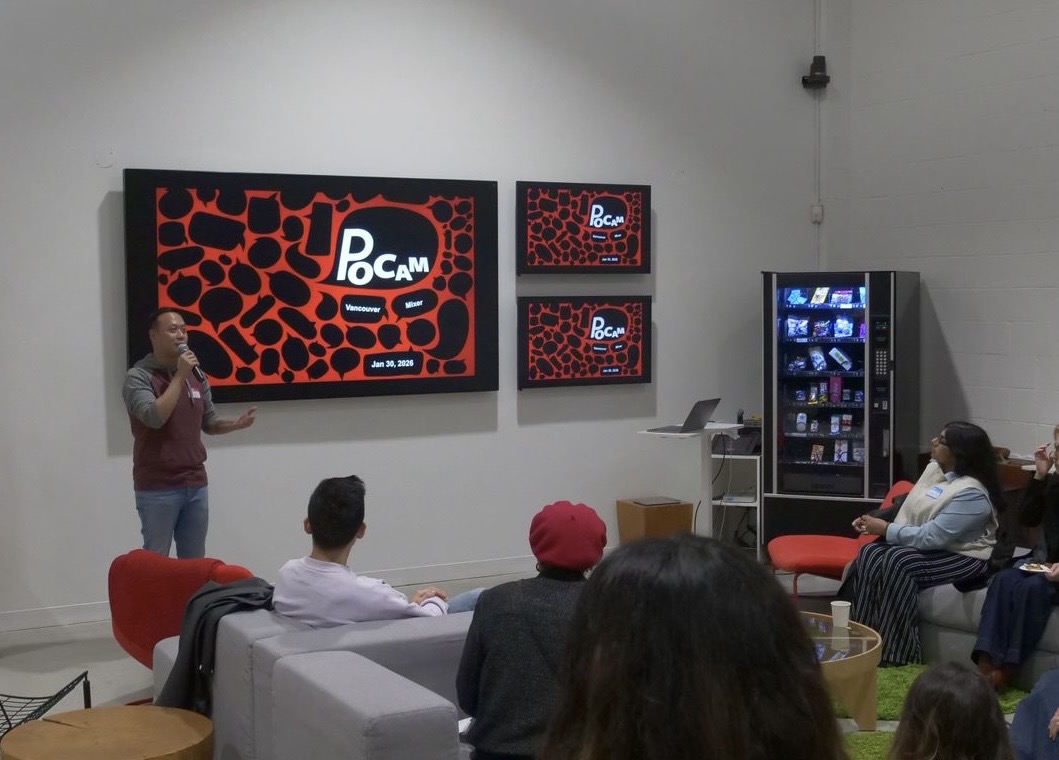
AndHumanity co-founder and brand director and POCAM steering committee member Matthew Tsang speaks during a launch event for POCAM’s Vancouver chapter last month.
BIPOC in Canadian advertising: A matter of survival
While there are industry leaders acknowledging the problem and taking steps toward change, Barrett argues that incremental progress isn’t enough when the stakes are existential.
“This is sort of the big lightbulb moment we had, that if we wait around for our good-intentioned white allies – dear friends, wonderful people – to make change, it’ll never come,” Barrett says. “Not because they’re not doing it, but because they are not energized with the same sort of survival instinct that applies to us who are living this every day. For us, it’s a matter of survival. We have to make the change happen quickly. The change is coming.”
Additional photos courtesy of Juanita Kwarteng and Yogi Omar.