 Images courtesy of the Government of Canada
To start the year, Health Canada mandated new “High in” front-of-package (FOP) label requirements for food products that exceed the daily value threshold of ingredients such as sodium, sugar and saturated fat. A new survey from Caddle gives insights into how the black-and-white warnings are influencing shopper behaviour.
The data-insight firm’s poll of approximately 900 shoppers last month shows that, of the 56.5% of Canadians who are aware of the new FOP standards, roughly three in 10 said would trade down to lower-cost or private-label items that don’t include a warning label and 21.6% said they would buy fewer processed or packaged foods due to the presence of FOP.
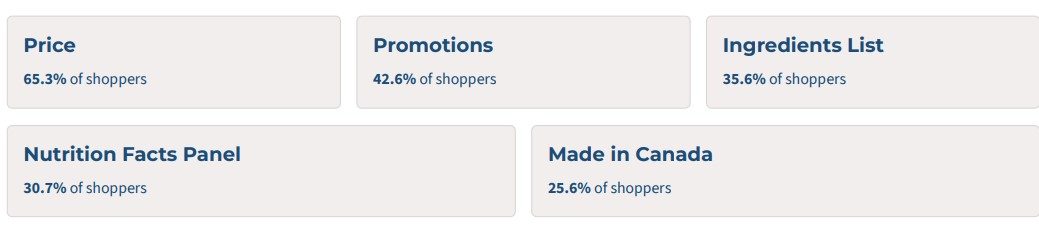
When choosing packaged foods, shoppers said they prioritize the importance of multiple on-pack elements, with price leading the way (65.3%) followed by promotions (42.6%, see, below). The 7.7% of shoppers in the poll who listed FOP labels as a top-three priority element proved highly reactive, with 81.1% saying they would change their behaviour if a product received a warning, compared to 55.9% of those who don’t.
According to Caddle, marketers should take note of the volume risk posed by FOP warning labels, as 28.2% of all respondents said they would consume less of a product if it came with such a marking and more than 9% said would stop purchasing a “High in” product altogether.
Caddle also recommends that brands prioritize product reformulation to avoid crossing warning thresholds and consider launching “no-warning-label” alternatives within the same brand family.