
(Image credit: Clair at Unsplash)
A new consumer report found that 50% of Canadians versus 38% of Americans say they have “low trust” in business communications about social and environmental impact.
The 2026 Conscious Consumer Report from Public Inc., in partnership with Ipsos and Engage for Good, includes data from approximately 1,000 Canadians and 2,000 Americans conducted last fall.
The report also revealed that 25% of Canadians report “no trust” compared with 30% of Americans. However, 62% of Canadians and Americans say they are “somewhat or very interested” in learning about a company’s social and environmental actions.
The report reveals different channel prioritization when seeking more intel on a company’s social and environmental actions, with on-product packaging and traditional advertising holding far more sway north of the border: 38% of Canadians vs. 33% of Americans demonstrate higher interest in on-product packaging, while 31% of Canadians vs. 28% of Americans seek out traditional advertising.
The study identified five key consumer segments, including “Sustainability Stewards,” “Ethical Enthusiasts,” “Mindful Moderates,” “Casual Contributors” and “Apathetic Actors,” rated on a scale of most conscious to decreasingly conscious. (See, below).
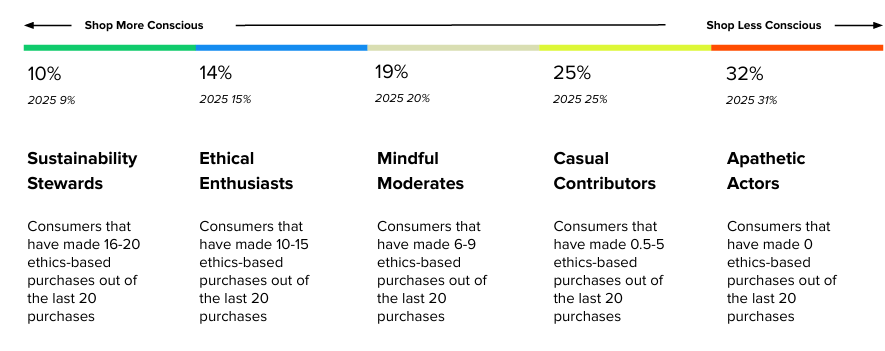
In Canada, “Sustainable Stewards” shop their values 80-100% of the time, are between 35 to 54-years old with children and have a university degree. On the other end of the conscious consumerism scale, “Apathetic Actors” comprise 32% of shoppers, make far fewer ethics-based purchases and both tend to be over 55 with no children.
According to the study, communicators need to take note that 68% of purchasers give some degree of ethical consideration to making a purchase, often resulting in brand switching.
According to the numbers, 59% of Canadians have traded a fresh food, coffee or tea, packaged foods product for another based on social, ethical and environmental reasons; 51% household goods; 46% Personal items such as cosmetics or hygiene products; and 39% wearable goods such as clothing and jewelry.
The most notable eco-messaging shift was in the “Made with Less Water” claim, which increased by six points year over year. Previously the lowest-performing claim in the category, it scored just 5% in both Canada and the U.S. After being reframed to highlight a clear, present-day benefit, its score doubled.
According to the report, to build trust, brands must match words with action, and that to demonstrate real progress on social and environmental commitments, requires supporting claims with credible internal and external validation.