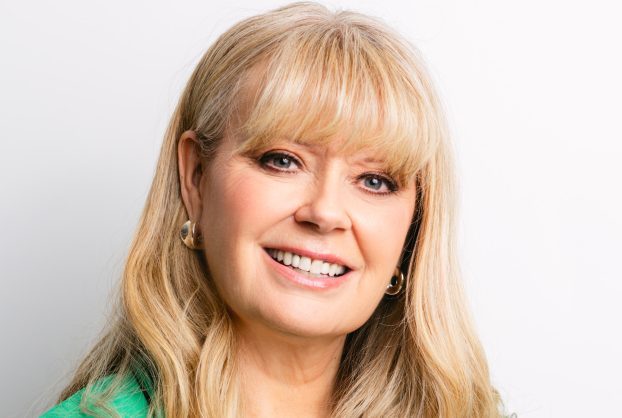
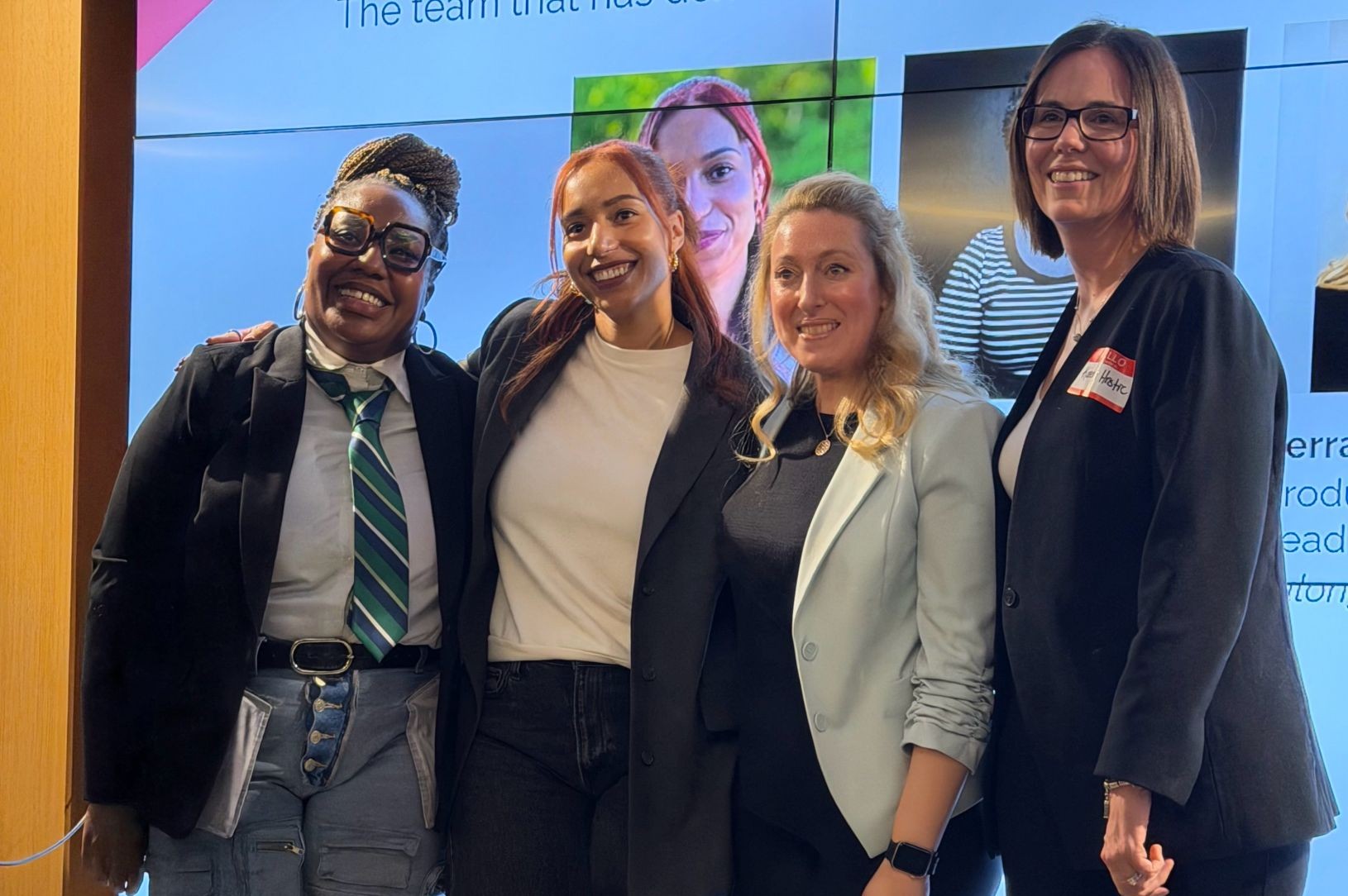
From left to right: BIPOC Inclusion Hackathon winners June Findlay, Lauren Russ-Constant and Serra Pinto Avimlah alongside Karen Hrstic, SVP of client leadership at Carat.
As Canada’s identity becomes increasingly multicultural and complex, marketers are still grappling with how to reflect that reality in their work. The Account Planning Group of Canada (APG) and People of Colour in Advertising and Marketing (POCAM) brought together some of the country’s top marketers and creatives on Wednesday night for the second edition of the BIPOC Inclusion Hackathon, an event aimed at fostering conversation about making industry communications more inclusive.
At Dentsu’s office in downtown Toronto, four teams gathered before a live audience of 100-plus and a panel of judges to present their prepared responses to the question, “Who are Canadians today and how can we more authentically connect with them?” APG and POCAM put out an open call to participants ahead of the event in partnership with industry leaders from Omnicom, Publicis, Dentsu, IKEA, Coca-Cola, Tangerine, Leger, Synqrinus, Barrett and Welsh, Fuse Create, Tulong and McMaster’s DeGroote School of Business.
“Fundamentally, the premise here is to redefine Canadian marketing by redefining ‘Canadian.’ What is a Canadian? Who is a Canadian? What makes us Canadian?” said event co-host Gavin Barrett, the vice-chair and co-founder of POCAM and founder of Barrett and Welsh.
Research presented to participating teams by Leger and Synqrinus in the leadup to the event suggested that Canadian identity is moving away from traditional national symbols toward deeper shared values. Respondents most often pointed to qualities such as kindness, multiculturalism and a sense of social security as defining traits of the country today. At the same time, the findings suggested brands should reflect the economic realities Canadians are facing, with roughly one in four saying advertising should acknowledge financial pressures rather than idealized lifestyles.
The insights served as a jumping-off point for the strategists, creatives and marketers who made up four teams (two focused on CPG and one each specializing in financial solutions and retail) exploring how brands might better reflect the complexities of modern Canadian identity.
Across the 15-minute presentations, teams challenged the industry’s tendency to treat inclusion primarily as a creative decision rather than a structural one, arguing that more authentic representation requires changes to research, product design and strategy itself.
The Financial Services Team emerged as the winner, receiving a prize of $1,200. Lauren Aisha Rush-Constant, June Findlay and Serra Pinto Avimlah argued that, while banking advertising often appears diverse on the surface, the products and systems themselves are rarely designed with the lived realities of racialized, newcomer and Indigenous communities in mind. To address that gap, the group proposed an “Inclusion Council,” a workshop-based framework designed to embed diverse financial perspectives directly into strategy, product development and campaign planning.
“The research was amazing, the data points were insightful and the solutions were disruptive in terms of where we are and where we can go,” said Jessica Borges, group VP and business lead at Visionnaire and hackathon jury member, in summarizing the perspective of the nine-person judging panel. “It was deep yet practical and it had a business imperative. Corporates want to be inclusive, but we also want to make money. And if you don’t make money, how do we put more money back into being diverse and inclusive?”
In the three remaining presentations, the teams each looked at inclusion in different sectors.
The Retail Team focused on the need for representation that goes beyond surface-level diversity in marketing campaigns, highlighting how brands often maintain Eurocentric sizing, styling and imagery while claiming to be inclusive. They proposed a framework emphasizing representation, economic realism, analytics and AI and language and locality to ensure campaigns resonate with multicultural and economically diverse Canadians.
Meanwhile, the two CPG-focused teams explored how packaged goods and consumer brands could better reflect Canadians’ lived realities.
CPG Team 1 emphasized intersectionality and everyday economic pressures, pointing out that 52% of the Canadian population is projected to be made up by newcomers by 2041 and arguing that marketing should acknowledge the financial constraints of different communities rather than idealized lifestyles.
And CPG Team 2 proposed structural adjustments to product and media strategies, suggesting that inclusivity in consumer goods requires changes to product development, messaging and media allocation, going beyond the level of diversity among models featured in campaigns.
Closing the event, Ishma Alexandre-Huet, chief design officer at Omnicom Media Canada and POCAM board member, said the ideas presented during the hackathon demonstrated the kind of systemic thinking the industry needs if it hopes to make marketing more representative of modern Canada and the diverse communities that it comprises.
“You all asked who was the system built for. You went way beyond tropes. You asked about the system and you asked for systemic change, and that’s what we need,” Alexandre-Huet said, addressing the participating teams. “You’re not looking for a ‘yes’ every time. If you get nine ‘nos,’ when you get the one ‘yes,’ you add it to the accumulation of what everybody in this room is working for, and that’s how we get to the next generation of making things better. So thank you for all the hope that you gave to us, and all the amazing ideas, and keep pushing for it.”
The decks for each presentation are being shared on the websites of both APG and POCAM. Wednesday’s event marked the second edition of the BIPOC Hackathon after its launch in 2024, an event that APG executive board member and co-host Michelle Lee said “went beyond tropes, tokenism and talk … to really shift the needle as it relates to diversity, equity, inclusion and actually do something about it.”
CPG Team 1
Casey Fletcher, group account director, OMD
Kriti Malhotra, associate director, Hearts & Science
Lee-Anne Beckett, senior strategist, T&P
Jale Gonulkapan Suder, strategist
Mentor: Jon Crowley, head of strategy, Fuse Create
CPG Team 2
Ashmita Ray, senior strategist, Monks
Fahim Khan, senior strategist
Suneel Mistry, CCO, Studio Two Seven
Mentor: Karina Black
Financial Services Team
Lauren Russ-Constant, strategist and founder, Selfhood
June Findlay, senior strategist, Little Kernel Communications
Serra Pinto Avimlah, product marketing lead, Tulong
Mentor: Sid Khanna, strategy director, 72andSunny
Retail Team
Arna Ajmani, planning assistant, PhD
Omar Rohaiem, sales marketing operations, Montalis Fine Foods
Tanmaya Ramprasad, account co-ordinator, AVCommunications
Mentor: Aaron Arellano, group strategy director, Dentsu