

Photo credit: Charles Deluvio/Unsplash
Marketing activity is becoming an increasingly significant driver of Canada’s economy, contributing $130.9 billion in GDP in 2024, according to new numbers released by the Canadian Marketing Association (CMA) and Signal49 Research.
The study, which uses customized data sets from Statistics Canada, says marketing activity had a similar effect on the Canadian economy as the retail and oil and gas industries, accounting for 4.6% of national GDP in 2024, up from 4.3% in 2019.
The report takes a broader view of marketing activity than traditional measures, which typically capture only specialized marketing firms through through code 5418 of the North American Industry Classification System. To capture the full economic contribution, the analysis also includes marketing payroll embedded in other industries. Using Statistics Canada employment and wage data, Signal49 calculated a “marketing intensity ratio” for each industry – the share of payroll attributable to marketing occupations – and used it to estimate the share of each industry’s GDP attributable to marketing. By combining these embedded roles with stand-alone marketing organizations, the study increases marketing’s measured GDP contribution from $7.8 billion to $130.9 billion.
“Marketing’s role in the Canadian economy is much bigger than many people think,” Esther Benzie, the CMA’s new president and CEO, tells strategy. “Many different businesses leverage marketing to grow their brands, grow their markets and reach their customers … we’re an engine of the economy that is really important and account for one in 25 jobs across the country, we have that breadth of economic impact.”
In total, the sector supported close to 861,500 jobs in 2024, or 4.1% of total employment in Canada – up from 754,200 jobs (3.9%) in 2019 – and generated close to $75 billion in labour income. The sector’s average salary of $86,900 in 2024 was roughly 30% higher than the national average of $67,100.
Signal49, formerly the Conference Board of Canada, chose the 2019 period as a benchmark year to compare with 2024 because it was not clouded by the economic effects of the COVID-19 pandemic.
Alan Chaffe, the associate director of economic research at Signal49, tells strategy that while marketing’s share of GDP has grown modestly over the period from 2019 to 2024, marketing activity is growing slightly faster than the overall economy.
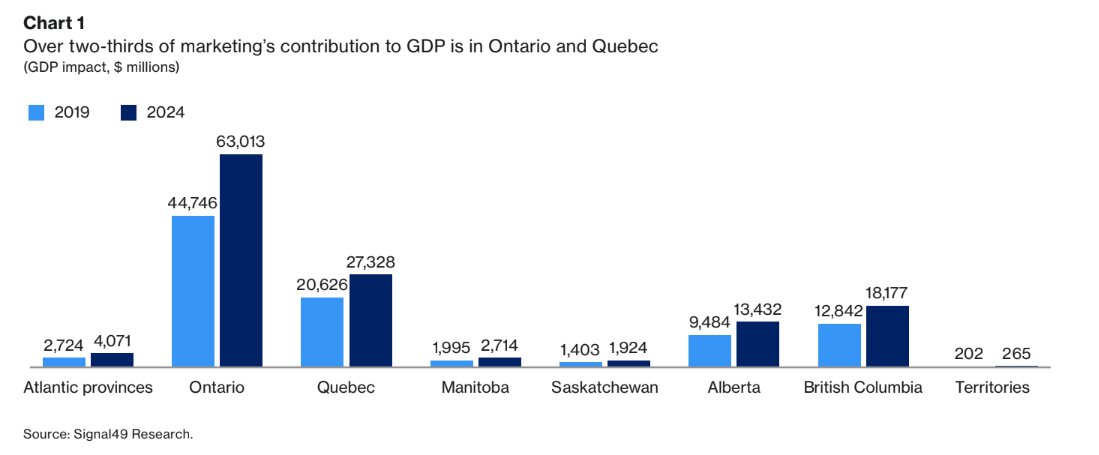
Regionally, Ontario and Quebec account for more than two-thirds of marketing’s effect on GDP, though activity is spread across every province and broadly reflects local economic size, Chaffe says, pointing out that Ontario slightly outperforms the rest of the country at 5.8% of provincial GDP.
“We’re seeing marketing activities driving or contributing to GDP in all regions of the country and if you looked at the size of each province and territory, it does align to that trend,” Chaffe says. “But Ontario does stand out, it actually does punch above its weight.”
The report also points to how marketing activity is being reshaped by technology adoption and shifting consumer behaviour.
More than 90% of Canadian businesses had some form of web presence in 2023, up from just higher than 85% in 2019, with company websites, social media and email marketing forming the core of that mix. Social platforms in particular have become central to how brands engage audiences, with adoption rising to 63% in 2023, compared with 57% in 2019. About 94% of small businesses in Canada post monthly to social platforms and more than 50% post daily.
By the end of 2023, 70% of Canadian B2C e-commerce companies were using AI, with another 26% exploring its use, far outpacing the roughly 12% of Canadian businesses overall reporting AI adoption in the second quarter of 2025. Among marketers themselves, usage is even more entrenched: three-quarters report using generative AI for business purposes at least weekly, primarily for content creation, research and ideation, with many citing gains in efficiency and productivity.
“AI is not going anywhere and technology is only going to continue to advance,” Chaffe says. “I think marketing is very much at the forefront relative to some other sectors and, I think as a result of that, it’s also helping drive the growth that marketing activity has on the economy.”
Influencer marketing continues to grow as consumers seek more authentic and relatable content, with nearly half of social-media users reporting they had made a purchase based on an influencer recommendation in the past year. Meanwhile, loyalty programs and personalization strategies are expanding rapidly, with Canadians belonging to an average of 22 programs in 2024, up from 14 the year prior.
The findings also point to growing expectations around data privacy and responsible data use as AI. Both Benzie and Chaffe emphasize the need for continuing investment in skills, ethical frameworks and regulation to support that evolution.
Looking ahead, Benzie stressed the need to ensure marketers are equipped to adapt and that “human insight is going to continue to be critically important.”
She also hopes the reports overall findings will help shift how marketing is viewed at the executive level, giving CMOs stronger footing to position their work as a growth driver rather than a cost centre.
“The study gives good data to encourage further investment into strong award-winning marketing programs,” Benzie says. “And it also shows that these are high-skilled, well-paid jobs that will hopefully continue to help us attract more great talent into the industry.”