The way audiences trust, discover and engage with branded content is changing. Fast.
Of course, that’s probably not news to anyone who’s worked in marketing in the last few years. But the bigger shift isn’t just about new formats or platforms. It’s about how content marketing itself is being redefined, both by technology and consumer behaviour.
That’s the throughline in Globe Content Studio’s Tactics & Takeaways 2026 trend report, created in partnership with WPP Media, which positions content marketing as something far more structural than just another campaign output. It’s less about execution, it argues, and more about new ways of building relationships, trust and integrity in an increasingly uncertain landscape.
Nowhere is that shift more obvious than in AI. While every platform and tool promises greater efficiency and speed, the reality hasn’t turned out to be that simple. AI has been quietly powering targeting, optimization and personalization for more than a decade, and yet the jobs it was supposed to replace haven’t disappeared. In fact, the report explains, advertising employment is projected to grow 6% in the US through 2034.
Even those promises of greater productivity haven’t quite panned out as expected. The Globe outlines how, in one study, developers expected AI to make them 20% faster, only to find it made them 19% slower. Not exactly the revolution marketers were promised. Meanwhile, consumers find themselves wading through “epic new levels of scaled content and slop” as brands chase attention in an increasingly automated ecosystem.
The answer isn’t more content, faster – it’s doing less, better. As Ahrefs’ Ryan Law puts it in the report, “any part of content marketing that can be fully automated by AI is destined to become virtually worthless.” What retains value is work that is original, trustworthy and human.
That growing trust gap is reshaping how brands think about environment and context. Tactics & Takeaways outlines how confidence in news has dropped to 52% in Canada (37% in the US), and how brand-safety tools are often overcorrecting – blocking ads from appearing next to credible journalism based on keywords rather than actual context.
The irony is that many of those environments still work. The Globe and Mail outlines a randomized study of more than 9,600 Canadians that found ads placed next to hard news performed just as well as those beside neutral content, with no meaningful difference in purchase intent or brand favourability.

Marketing of electric vehicles (EVs) is one of the topics covered in the trend report, examining how broadly car makers have diversified on the powertrain front. Now, after buyers pick their vehicles, they might have up to five engines to choose from. A winning marketing strategy is turning the current EV uncertainty into control.
That same tension is playing out in how audiences are making decisions. Canadians still haven’t quite gotten over recent remarks by US President Trump, and it’s showing up in consumer behaviour in very real ways. In The Globe’s own survey, 54% of readers say they avoid US products when possible, while 44% actively seek out Canadian alternatives. Travel patterns are shifting, too, with 55% of respondents avoiding US travel in 2025. Even media consumption is tilting local, with 42% saying they are cutting back on American media and 20% ditching US TV altogether.
All of this is happening against a backdrop of fatigue. Years of doomscrolling, algorithmic feeds and AI-generated content have pushed people into a kind of digital burnout, forcing marketers to rethink how attention – and trust – is earned.
That’s part of what’s driving a resurgence in experiential marketing. The report outlines, for example, how Apple TV+’s Severance recently turned a Grand Central Station pop-up into a measurable growth engine, driving a 126% jump in new subscribers. These kinds of activations don’t just generate buzz – they create participation, memory and cultural relevance. As feeds fill with fake content and algorithms determine discovery, real-world experiences offer something increasingly rare: real, unfiltered connection. Physical activations, from pop-ups to immersive installations, are helping brands rebuild that sense of community and shared experience, something digital alone struggles to replicate.
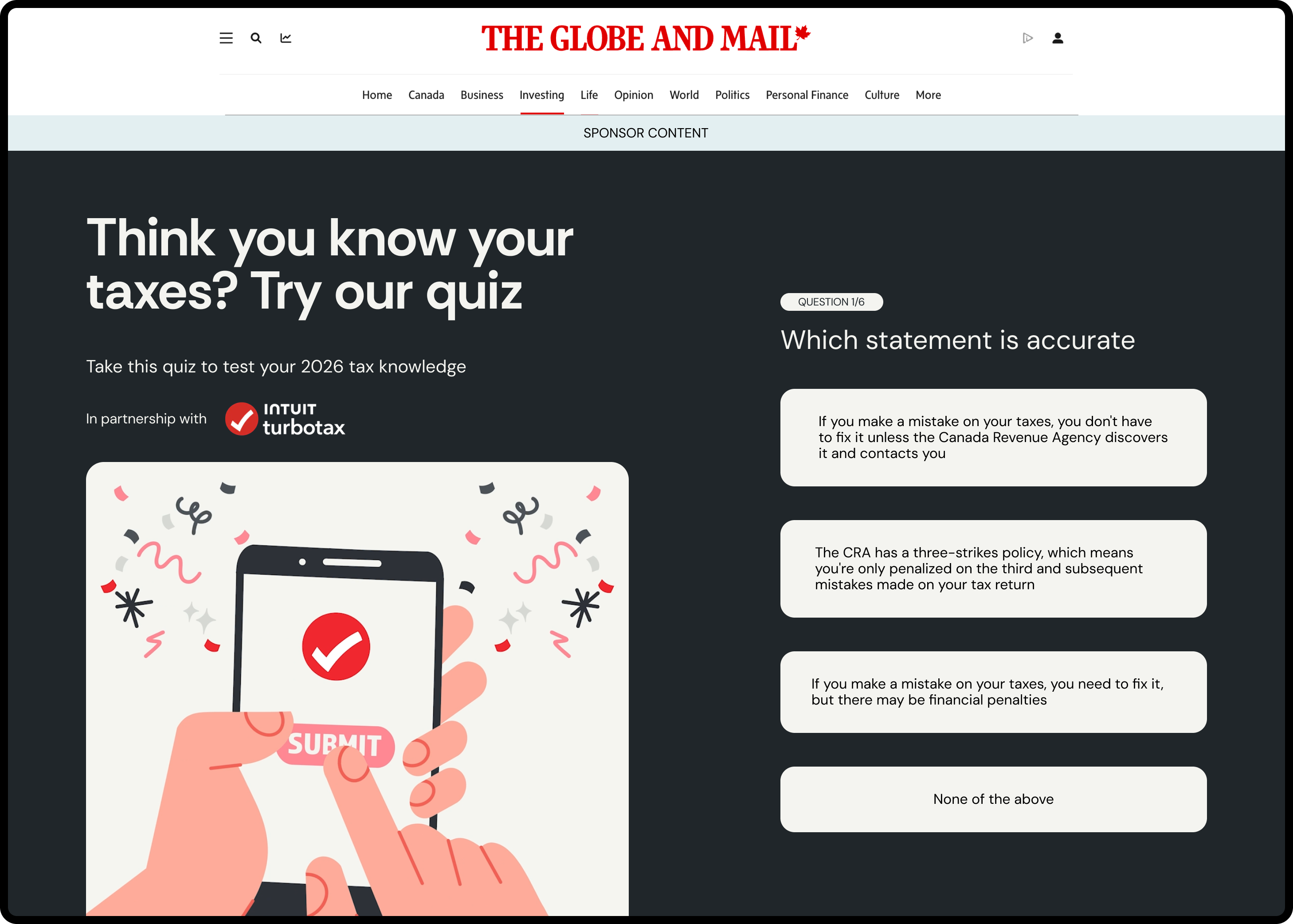
The trend report also looked at how marketing is starting to prioritize attention over reach, and brands are borrowing from game designers to keep users engaged with their content. In this example, sponsored by Intuit, Globe Content Studio designed a quiz to spur interest in the company’s TurboTax product.
For brands, it’s a constant balancing act. Scale still matters, but relevance is increasingly defined by proximity: cultural, geographic and emotional. Content that reflects local nuance and identity is more likely to land.
So, how do you break through? It all comes down to trust.
As AI floods feeds with content, platforms make it harder to know what’s real, and privacy regulations change, marketers are being pushed toward more intentional, more accountable strategies. Passive impressions matter less. Active participation matters more.
Publishers are no longer just distribution channels. They’re becoming full-funnel content engines, combining storytelling, targeting and measurement to move audiences from awareness to action.
What Globe Content Studio’s latest report shows is a more mature model of content marketing. One that prioritizes trust over scale, substance over volume and long-term value over short-term gain. A model built not just to capture attention, but to earn it.
Download the free 2026 Tactics & Takeaways Trend Report here and level up your content marketing game.