Lana Castleman’s article was previously featured in the Summer 2026 issue of Strategy Magazine.
At 240 years old, Molson has spent nearly a quarter of a millennium helping define Canadian identity. Now, as it marks its ten-24 anniversary, the brewer is finding new ways to stay relevant in a country that looks very different from the one it helped build.
It’s not every day a Canadian brand gets an unsolicited nod from a global superstar like Drake, let alone twice within the span of a few years. Then again, with 240 years of history in Canada and counting, there are few that rival Molson in terms of cultural heritage.
In July 2023, Drake was spotted wearing a vintage 1998 Molson Canadian baseball jersey which Molson turned into a viral award-winning digital campaign that drove an estimated 2.5% bump in sales.
“We relish being in those moments and it speaks to the power of [Molson’s] credibility and the trust we have built with Canadians.”
More recently, Eric Kouri, the newly appointed Molson Coors marketing director of trademark and economy brands, and his team found themselves pleasantly surprised on the morning of Friday, May 15, 2026 – a.k.a. the drop date of Drake’s first solo album in three years. In the “Slap The City” video, Drake stood at centre ice of a figure-skating rink draped in a fur coat featuring a patch of the the classic Molson Canadian logo, alongside others from RBC, Canadian Tire, Manchu Wok and Sleep Country.
“That was a roller coaster of a Friday, if I’ve ever had one,” Kouri recalls. “But we relish being in those moments and it speaks to the power of [Molson’s] credibility and the trust we have built with Canadians.” Molson immediately took to its social channels and started riffing with the other brands, even taking a straw poll on whether to reproduce that coat.
“People are still looking for ways to have dialogue with brands. Especially now. More than ever, they want to participate versus being told,” he adds.
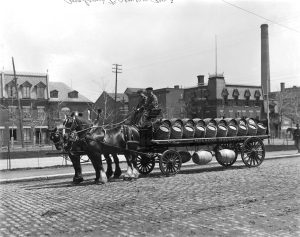
What beer delivery looked like in 1786.
First established in Montreal as a brewery by John Molson in 1786, the brand was Canadian before Canada officially came into existence 81 years later. It’s been a leader in beer advertising and marketing since 1807, when John bought and placed his first newspaper ad.
Arguably, Molson’s marketing has done as much to shape ideas of Canadian identity as it has to reflect the country’s evolution over the past two-plus centuries, helping keep the brand top of mind among beer consumers.
There’s no better example of that than the groundbreaking “I Am” campaign (from MacLaren McCann) for Molson Canadian in 1995, which reached its zenith with 2000’s “The Rant.” Recited by Joe Canada (actor Jeff Douglas), the 30-second tongue-in-cheek spot recounted what Canada was and was not, including our belief that the beaver is a “truly proud and noble animal.” It ran in theatres, on TV and Douglas even appeared in character at hockey games. It was hugely successful and continues to influence marketers today.
But the beer industry at the time was also becoming distinctly less Canadian. The 2000s marked a period of amalgamation that saw Molson merge with U.S. beer giant Coors in 2005 to remain competitive with growing international conglomerates.
At the same time, beer as a category has been in decline. In fact, beer sales in Canada have been steadily declining since 2004, falling from roughly 49% of all alcohol sales to 35.1% (CDN $9.1 billion) in 2025, according to Statistics Canada.
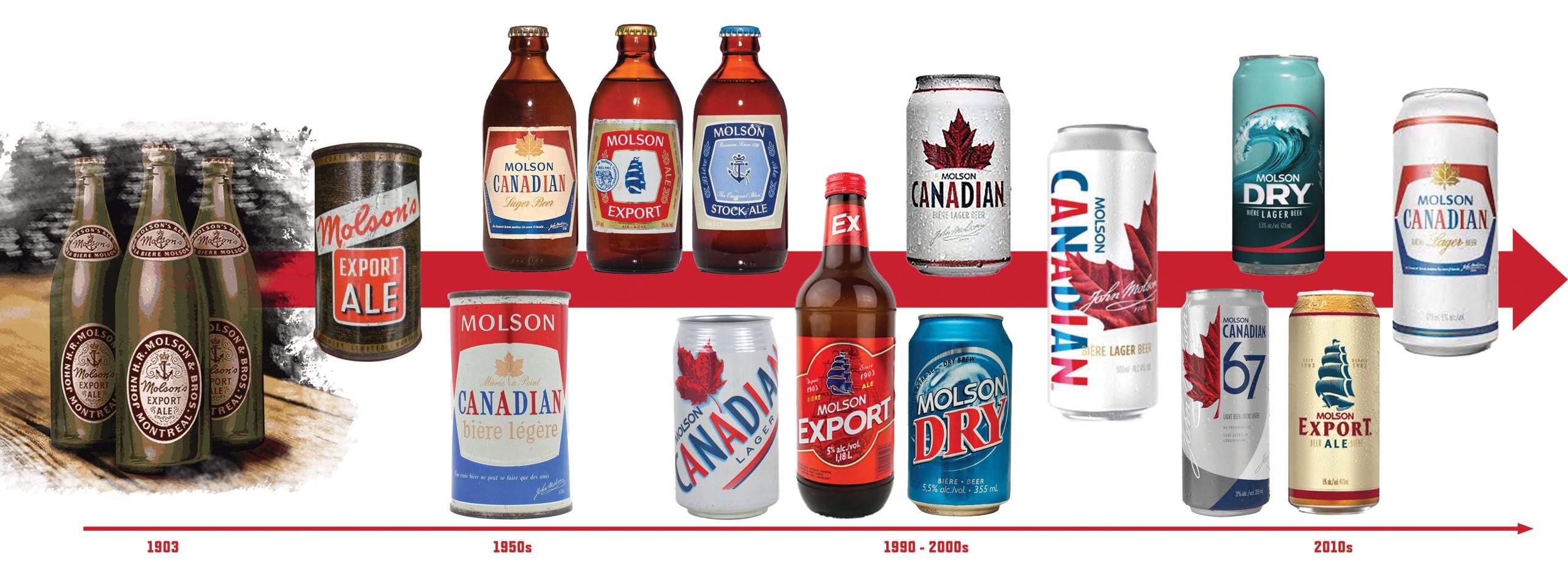
The Molson line-up has evolved significantly over the years, perhaps no more so than from 1903 to the present.
It was in this environment, around 2019, that Molson began rebuilding its brand platform with AOR Rethink.
Recognizing that core Molson beers – Canadian, Export, Dry, Ultra and non-alc Exel – and the “I Am” positioning were no longer connecting with consumers as strongly as they once had, the company set out to create a marketing platform that would uphold Molson’s legacy while attracting a new generation of drinkers.
The idea behind it was to move away from the singular “I” positioning to the Canadian collective “we,” using the brand to bring people together rather than define them individually.
The new brand platform “Everyone In” launched in March 2023 with a spot that featured “One Dance,” a track by (who else) Drake, and depicted people enjoying Molson brews at Vietnamese restaurants, salsa clubs, drag brunches – not just the neighbourhood local – showcasing the breadth and diversity of Molson consumers.
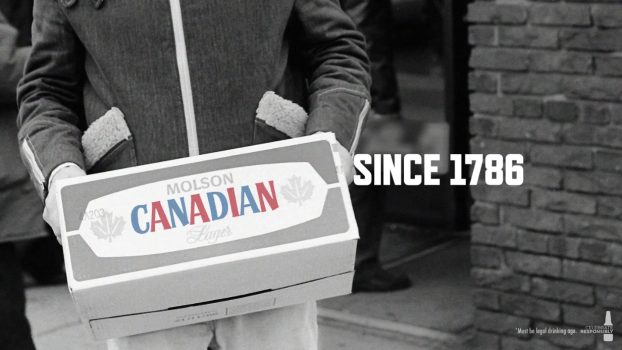
The “Since 1786” campaign featured a 30-second spot that echoed “The Rant” in sentiment.
It also brought all five beers under one umbrella for the first time and featured branding that drew inspiration from the original Molson script logo, while introducing a modern hexagon to create visual consistency across packaging and marketing executions.
“‘Everyone In’ embodies what this brand has always stood for, which is bringing people together, bringing Canadians together, rallying people behind the country that we call home,” Kouri says. “It really has been a great unlock for the brand in terms of bringing forward creative ideas that have had some really strong cultural resonance.”
The 2023 “Everyone In” launch campaign led to Molson being named a strategy Brand of the Year. It also helped drive a 4% growth in volume over the prior year as well as an 8.4% jump in revenue.
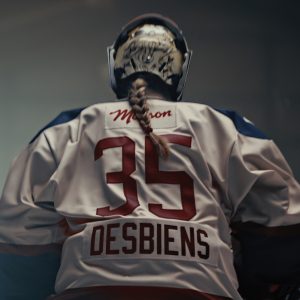
“See My Name” helped to establish Molson as a beer for ALL hockey fans.
And the innovation continued.
Kouri points to one 2024 campaign in particular that he describes as a “culture drop,” one that leaned into Molson’s longstanding relationship with sports while solving a real-world problem.
“See My Name” helped to establish Molson as a beer for all hockey fans, spotlighting the issue of name visibility on PWHL (and later non-pro) jerseys. When positioned traditionally at the top of the jersey, not only were female players’ names less recognizable than their NHL counterparts’, they were also often obscured by their ponytails or braids. Molson stepped in, teaming up with the PWHL to redesign the back of the jersey, placing a Molson logo at the top and the player’s name across the bottom, where it would be clearly visible.
The campaign launched on Women’s Day 2024 across TV and digital platforms and resulted in a 75% increase in PWHL player-name recognition, generated 2.9 billion impressions and sits as the most-shared campaign in Molson history.
Another standout was “Paid Through Parents’” which found a novel way to get money to underfunded amateur athletes competing in the 2024 Summer Games by essentially turning the parents of nine athletes into legal financial intermediaries.
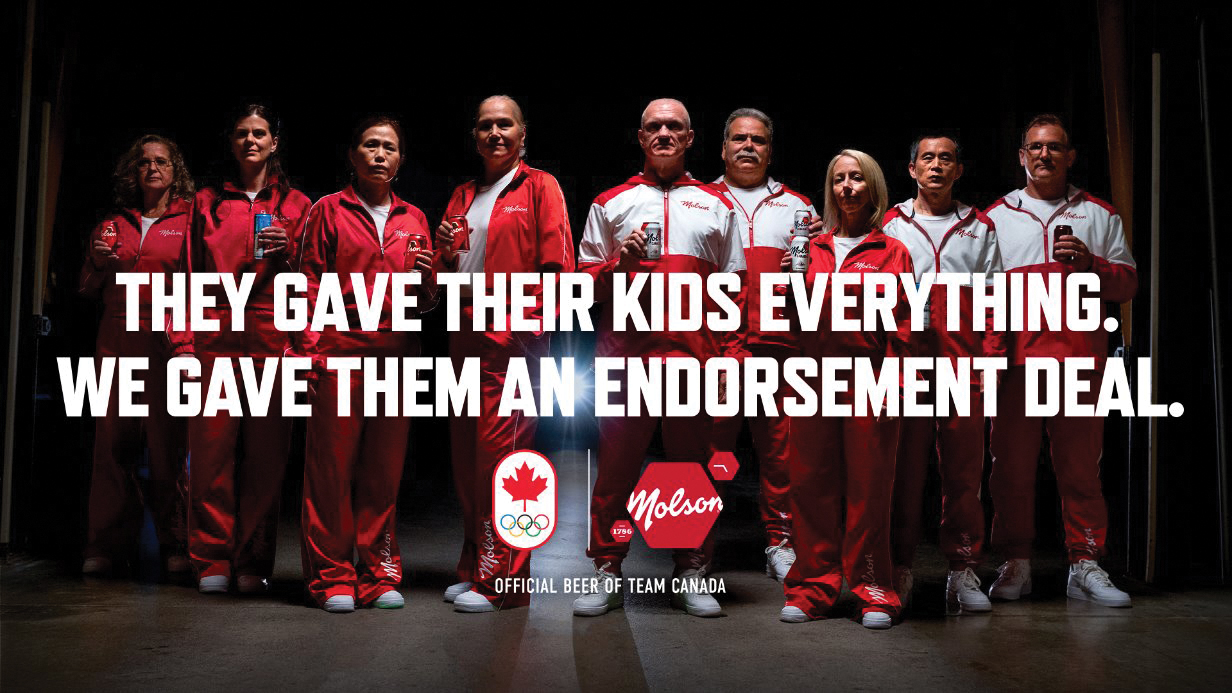
“Paid Through Parents’” found a novel way to get money to underfunded Olympic athletes.
Molson gave the parents $15,000 each to pass along to their children, no strings attached. A full TV, digital, social and PR campaign supported the effort, starring the parents themselves. It generated more than 389 million impressions across media, connected TV and OOH, while owned channels delivered another 19 million. The initiative increased athlete compensation by 15,000% compared with previous Olympic Games.
“The Canadian identity can’t be defined by one voice, and that’s part of the reason why we decided to do this.”
The next year saw the “Since 1786” campaign with a 30-second spot that echoed “The Rant” in sentiment, with the focus instead on the collective. It featured phrases like “Since when were Canadians not sorry… Since 1786,” all backed by Rush’s iconic “Closer to the Heart.” It was followed by “We’ve Been Everywhere” that featured Men Without Hats’ 1980s banger “Safety Dance.”
Kouri says the ad was designed to celebrate Molson’s deep roots in Canada and the many ways beer is enjoyed across the country, reinforcing the “Everyone In” platform. Molson Canadian’s sales grew by 2.9% in volume in 2025 vs. 2024 and the Molson Canadian brand also grew total market share by more than a quarter of a share point in the same period.
To celebrate its 240th, Molson closed the circle and handed the “I Am” campaign directly to consumers with “Made by Canadians.” Taking an intentionally analogue approach, Molson placed disposable cameras across Montreal, Toronto and Vancouver, then sent followers on a treasure hunt to find them and submit photos of what they believe is uniquely Canadian.
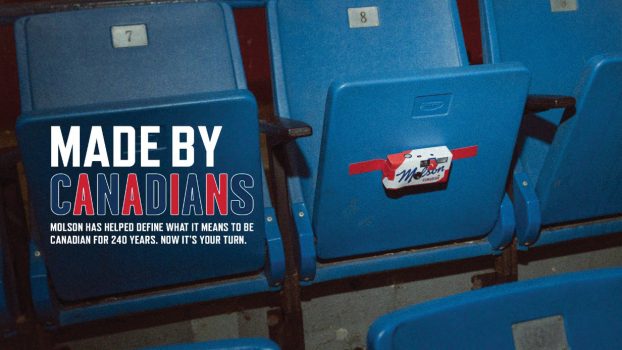
To celebrate its 240th, Molson launched its “Made by Canadians” campaign.
“The Canadian identity can’t be defined by one voice, and that’s part of the reason why we decided to do this,” Kouri explains. Success, he says, will be measured by the number of submissions and the extent to which the final crowd-sourced portrait, created by Rethink, is shared and discussed.
“We look at our history and legacy as a superpower. It’s not a constraint,” he says. “That legacy and credibility have allowed us to be a part of a lot of these cultural moments that not all brands would be afforded the opportunity to dive into.”
Beyond structured campaigns, Kouri says Molson’s history gives the brand permission to be more reactive and opportunistic – an increasingly important advantage in today’s digital-first marketing environment.
Storytelling, he says, needs to inform, reward attention quickly and stop the scroll. Molson focuses on simple narratives that tap emotional levers such as humour and reflection, while recognizing that the brand itself can still play a meaningful role in cultural conversations when the moment is right.
He points to a recent activation in Buffalo that turned a viral NHL playoff moment into a cross-border extension of the brand’s “Cheer Canada” platform.
Buffalo Sabres fans stepped in to finish singing “O Canada” when the microphone cut out during the anthem before a playoff game against the Boston Bruins. Within a week, the Molson team had transformed the moment into a cross-border activation, buying Buffalo fans a beer at the next game – and at 17 bars across Upstate New York – while supporting the effort with OOH billboards reading “This Playoffs, Cheer Canadian” throughout Buffalo.
“We’re going to stay focused on growing it through connecting with more consumers and finding new occasions for the brand.”
The activation was delivered with support from multiple agency partners. Zeno Group led PR and earned-media efforts in Canada and the U.S., while Publicis Connect handled media planning and buying. Creative support came from The Team.
As important as agility is today, Kouri says the focus for the next decade will be on occasions – maintaining existing beer-drinking moments while helping create new ones. To that end, Molson plans to become more present wherever beer naturally fits into people’s lives, from major celebrations and sporting events to weekly rec-league meetups and summer barbecues.
“We still have big ambitions for the Molson brand. We’re going to stay focused on growing it through connecting with more consumers and finding new occasions for the brand,” Kouri says. “Our job isn’t just to respect our 240 years of history. It’s to make sure Molson still matters 240 years from now.
“That will mean continuing to champion our role in Canadian life while also finding ways to evolve alongside changing consumer preferences.”
-All images courtesy Molson