Will Novosedlik’s article was previously featured in the Summer 2026 issue of Strategy Magazine.
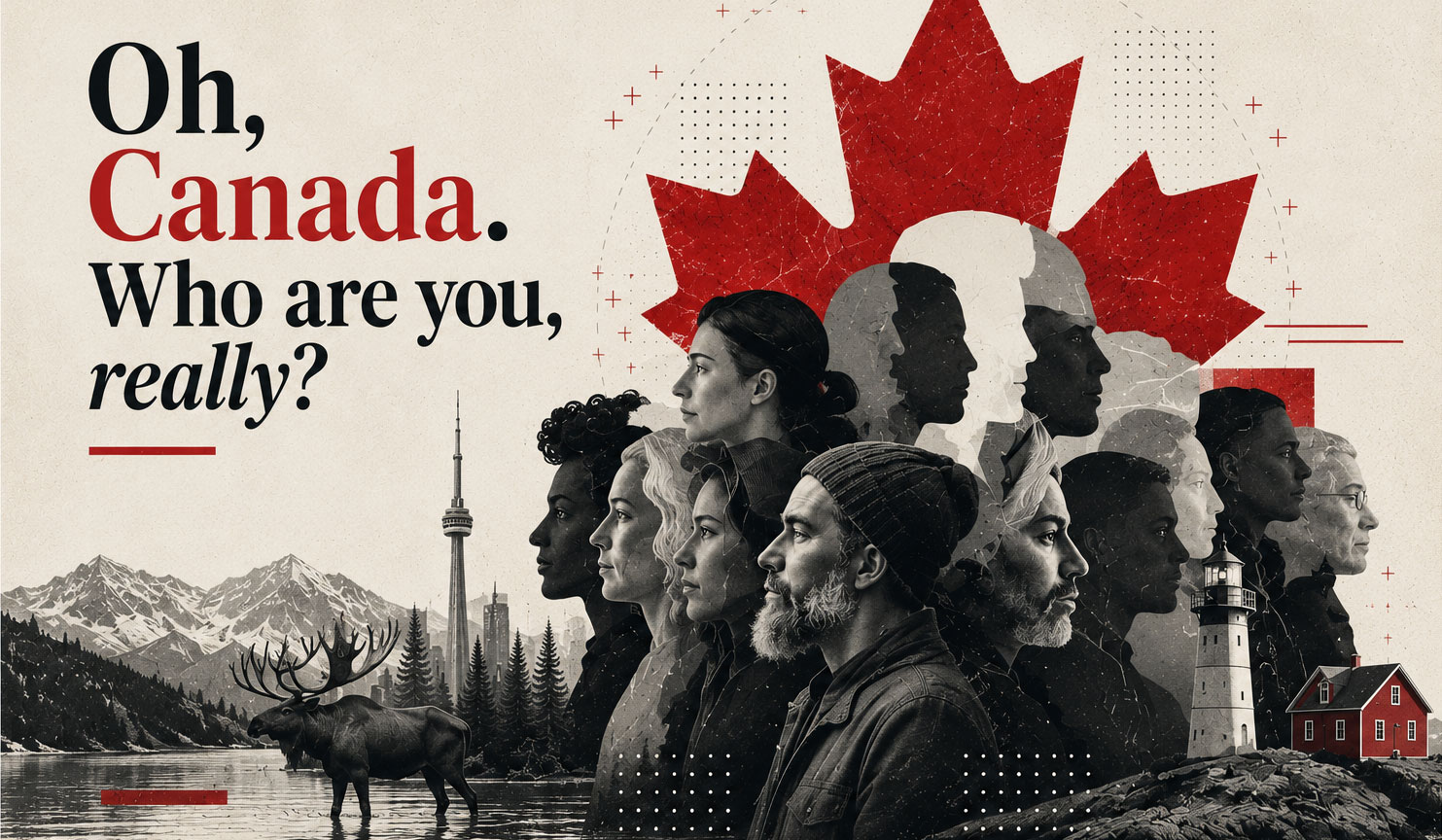
Is “Canadian identity” still a useful marketing lens? The honest answer is yes, but not in the way it has traditionally been used. So how do you market to a country that no longer sees itself through a single, unified story?
In his 2002 book, Souvenir of Canada, Douglas Coupland writes, “Canada is a staggeringly young country, and we really ought to be easier on ourselves than we are. We beat ourselves up trying to define ourselves when, comparatively, we’ve generated more myth and identity in our short lifespan than many countries ever did before their 135th birthdays. There’s only so much national mythology that can be created in 135 years. Relax.”
At the time, that idea felt comforting. Canada didn’t need to define itself too rigidly because its identity still felt open-ended and unfinished. But the question now isn’t whether Canada has mythology, it’s whether that mythology still reflects the country marketers are trying to speak to.
Myths are often seen as lies dressed up as comforting fairy tales we tell ourselves to paper over the ugly parts of our culture and history. But when that veneer is stripped away – for example, when our sovereignty is threatened by a powerful neighbour – we’re forced to confront reality.
According to the 2021 census, the Indigenous population grew by 9.4% between 2016 and 2021, almost double the 5.3% growth rate of non-Indigenous Canadians. And yet Indigenous perspectives are still too often absent from marketers’ understanding of the country.
Church + State’s Ron Tite argues that the industry has become too comfortable relying on what he calls “the safety of the Canuck stereotype.” The problem isn’t simply that the stereotype is outdated, but that it reduces a complicated country into something overly neat and marketable. We’re neither the country nor the people we were even 50 years ago. Little wonder, then, that the stereotype is starting to feel out of date.
According to Rethink global CSO Sean McDonald, another stereotype we need to put in the waste bin is that “the world needs more Canada,” because it misses the nuance of what Canada is: accepting, hardworking, outward-looking and highly educated. But we don’t talk about that.
And even that framing doesn’t go far enough. Luc Dumont, SVP insights at Leger Marketing, looks beyond the Canuck stereotype to remind us that 1.8 million Canadians are Indigenous. That’s 5% of the population. According to the 2021 census, the Indigenous population grew by 9.4% between 2016 and 2021, almost double the 5.3% growth rate of non-Indigenous Canadians. And yet Indigenous perspectives are still too often absent from marketers’ understanding of the country.
Which exposes the deeper problem with “Canadian identity” as a marketing construct: there is no longer a single version of Canada to reflect back.
As Hilton Barbour, VP marketing research and training company Institute for Health and Human Potential, notes, “Whenever marketers talk about Canadian identity, I do wonder what they’re talking about. The momentary impulse behind ‘elbows up’ seems to have dissipated as Canadians moved on to more tangible and real challenges like inflation, shrinking economic opportunity and no immediate end to challenges around affordability.”
Reality 3. Mythology 0.
It seems like just about every celebrity we have ever produced, whether in academia, entertainment or literature, has been asked to define what it means to be Canadian. In many ways, uncertainty may be one of the country’s few enduring cultural constants.
The friction runs through almost every perspective on the subject. It’s also hardly a new debate. Canadians have been questioning the coherence of their own identity for decades.
It seems like just about every celebrity we have ever produced, whether in academia, entertainment or literature, has been asked to define what it means to be Canadian. In many ways, uncertainty may be one of the country’s few enduring cultural constants.
Take Marshall McLuhan, who said, “You can be a French Canadian or an English Canadian, but not a Canadian. We know how to live without an identity, and this is one of our marvellous resources.”
Is that ambiguity our identity? Margaret Atwood, who has probably thought about this more than anyone else, once quipped that “the beginning of Canadian cultural nationalism was not ‘Am I really that oppressed?’ but ‘Am I really that boring?’” – perfectly capturing the understated, self-deprecating quality she saw as distinctly Canadian.
More recently, popular culture has offered its own interpretation. For Eugene Levy, the values embedded in Schitt’s Creek – kindness and acceptance – reflect what he sees as Canada at its best. The show’s fictional town and its portrayal of LGBTQ+ characters were groundbreaking precisely because of how normal it felt.
Which brings us back to the core question: If Canadian identity still matters in marketing, what version of Canada are brands actually reflecting?
Canadian identity as a lens isn’t obsolete. But it needs to be held more lightly, applied more locally and grounded far more in the texture of lived experience than in the iconography of national mythology. The strongest work isn’t trying to define Canada for everyone. It’s reflecting specific versions of Canadian life with honesty and precision. The brands getting this right aren’t the ones waving the flag more cleverly. They’re the ones paying attention to how Canadians actually live.