Ahead of the 50th anniversary of the 1976 Summers Games, Quebec government agency Parc Olympique wanted to honour the legacy of the 1976 Games while reinvigorating the site as a destination for future generations.
The challenge was particularly relevant as Parc Olympique looks to expand Montreal Olympic Park’s role as a venue for sports, culture and public events. The Quebec government last month approved an $870-million project to update the interiors of Olympic Stadium, with the aim of attracting larger-scale sporting and cultural events to Montreal.
To promote the new positioning, Parc Olympique turned to LG2 to develop a new visual platform to celebrate Montreal’s moment on the global athletic stage and forward its legacy into the 21st century. The assets showcase archival images of athletes and landmarks coupled with a palette of concrete grey, Olympic red and medal gold alongside a typeface that traces the original Univers font at A 45-degree angle, echoing Montreal Olympic Stadium’s 165-metre tower.
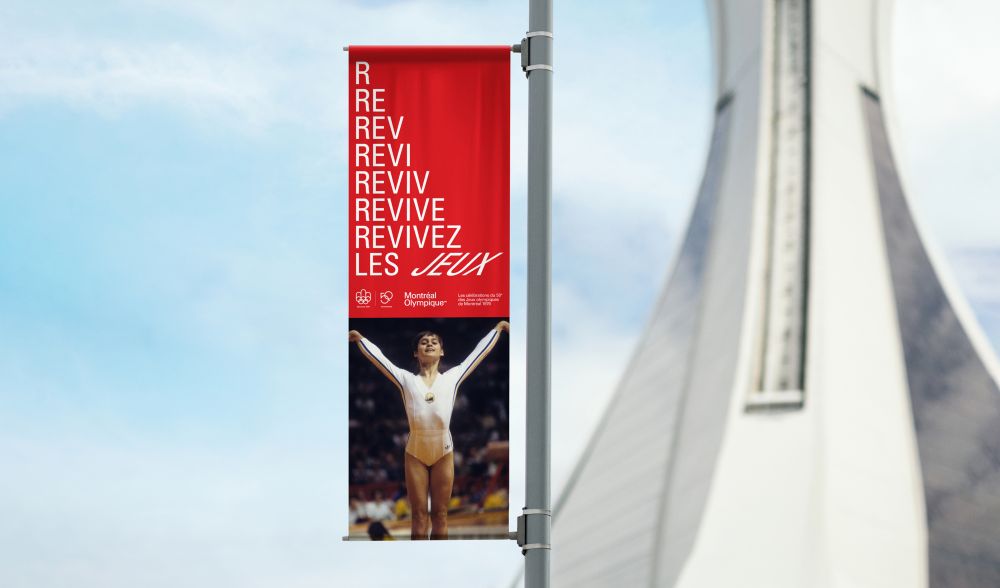 Images courtesy of Parc Olympique
“The 1976 legacy is an integral part of the Olympic Park’s identity, it gave Montreal its most recognizable landmarks and anchored a distinct creative heritage that continues to resonate,” says Christina Pagé, managing director of the Quebec government agency Parc Olympique. “However, this anniversary is less about looking back than about expanding the narrative.”
LG2 creative director Marie-Pier Gilbert says the challenge went beyond celebrating the past; the agency had to advance legacy imagery into a forward-looking set of visual codes that could “ripple into the future.”
Fortunately, the original iconography created by Georges Huel and fellow French-Canadian designer Pierre-Yves Pelletier pointed the way forward through a timeless Canadian Modernism esthetic. LG2 took inspiration from the Games’ minimalist logo, iconic architecture and imagery to carve out a multi-faceted design system that could live across OOH, video and digital that could signal pride in the past while appealing to a younger generation.
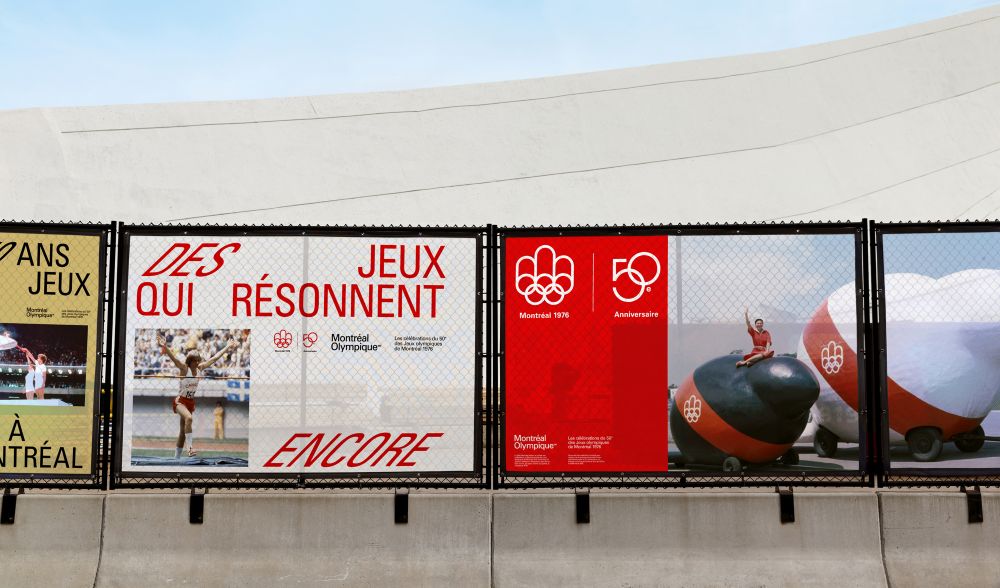
Parc Olympique’s new visual platform appears prominently throughout the summer’s anniversary activations, including free events such as an archival exhibition inside the Olympic Stadium Rotunda, an open-air photographic display along Pierre-De Coubertin Avenue and a free outdoor variety show at the Esplanade Pie-IX on Aug. 1 that celebrated the anniversary of the 1976 Games’ closing ceremony.
“Beyond honouring the historic legacy of 1976, the main strategic challenge was avoiding a purely nostalgic, archive-driven look-back,” Gilbert tells strategy. “Ultimately, the system needed to strike a delicate balance: honouring the city’s architectural heritage, celebrating the enduring institution of the Games, and highlighting active, living venues, all while serving as an adaptable design program that acts as a catalyst for contemporary community pride and connection.”