As brands chase bigger partners with deeper pockets, this year’s Cannes Lions in Entertainment Lions for Sport Grand Prix offers a different lesson: “Your No. 1 sponsor is always going to be your fan,” Shannon Washington, global CCO and managing partner at New York-based studio 11 Ounces, tells strategy.
The Entertainment Lions for Sport’s Grand Prix-winning campaign from Peru, “The 1,000 Sponsors of Muni,” harnessed the passion of supporters and turned it into real economic value.
Founded in 1935, the work followed football club Deportivo Municipal after it fell into Peru’s third division and was grappling with severe financial difficulties, including the loss of its main sponsor. To help keep the club afloat, the campaign invited 1,000 fan-owned small businesses to collectively become sponsors through micro-investments. In return, the businesses received branding space on the team’s jersey and official supporter status, transforming community passion into a new model for funding a football club, all while supporting the local economy.
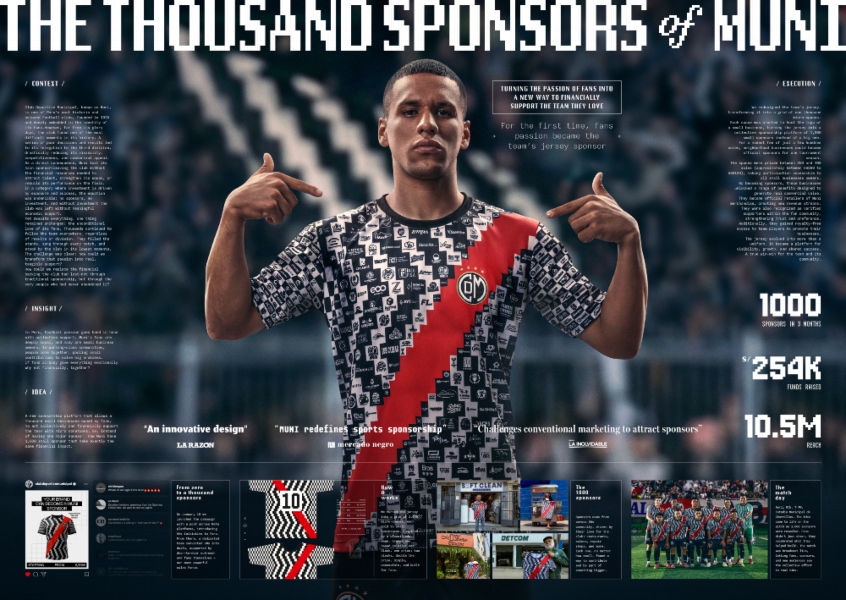
Image courtesy of Club Deportivo Municipal
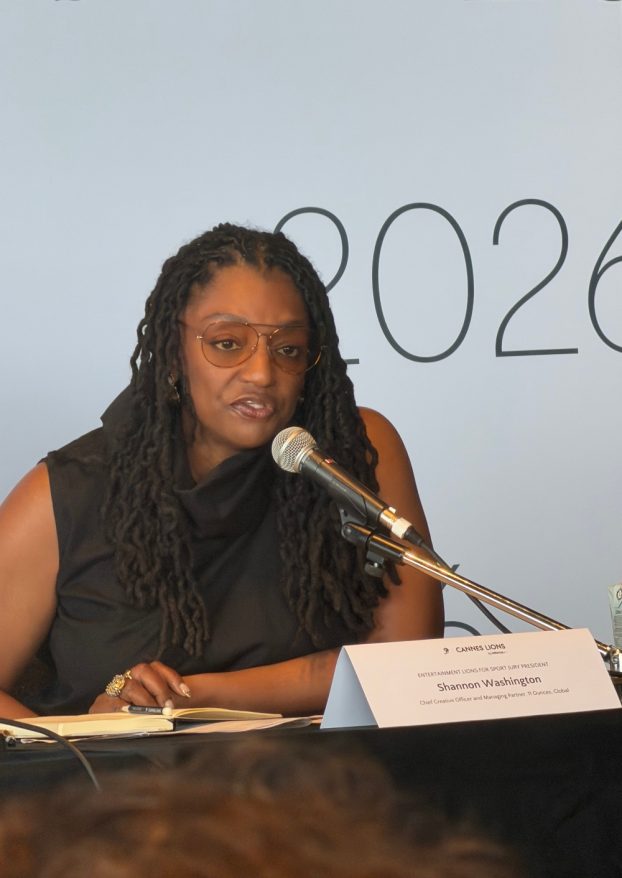
According to Washington, the Lions for Sport jury president, the winning work demonstrates that communities can be more than an audience: They can become active participants, investors and advocates. The campaign didn’t simply secure sponsorship dollars for a struggling club; it reimagined the sponsorship model altogether by turning fans and local businesses into collective stakeholders.
While Canada was shut out of the Grand Prix in Entertainment Lions for Sport, it still delivered a strong showing with two Silver Lions and one Bronze Lion. One of the silvers went to KFC’s “Kyle F*cking Connor” by Courage, while the other was awarded to Adidas’s “Supernova Adaptive” by TBWA\Canada. The bronze went to True Hockey’s “Game on Ball” by Dentsu Creative.
Washington says the Canadian work resonated because it felt deeply rooted in culture and community. She repeatedly described the entries as “very Canadian,” praising campaigns that celebrated hockey fandom, neighbourhood play and adaptive sport while tackling real-world issues through creativity.
But she also suggested that Grand Prix success at Cannes often comes down to scale. Canada’s work wasn’t missing anything creatively, she said; rather, the differentiator at the highest level is often the breadth of impact, the ability to expand an idea beyond a controlled environment and the evidence that it can create change at a larger scale.
Her advice to agencies was equally pragmatic: Not every piece of work needs to be entered immediately. In some cases, allowing an idea more time to grow, gather results and prove its potential can make the difference between a shortlist and a Grand Prix contender.
Strategy spoke with Washington after the category’s winners were announced Tuesday.
How is Canada doing, and what stood out about the work that didn’t win the Grand Prix?
There were three pieces out of Canada that I really love for various reasons.
“Kyle F*cking Connor” is possibly one of my personal most favourite pieces of work that I’ve seen this year. I’ve judged other shows where it did very well as well.
Speaking selfishly, I work with a team that has a whiteout game. I work with a team that works with local businesses. So to see how this big brand, this one store, showed up for this team in a way, I thought was really brilliant.
I thought it was really indicative to the culture of hockey, the culture of fandom, and just having fun – put the bucket on your head, these things that we do as fans that kind of isolate us from the rest of the world in a way.
On “Game On Ball,” that was something that we talked a lot about. There’s always going to be a piece of work that uses technology to hack something, but at the root of it, I like the fact that they were really steadfast that this is a stunt in a way and we’re doing it to make a point about, not only just street hockey, but the idea of kids playing outside and the power of sport.
I mean, I could go on even as a former educator. The idea of play is so important in children. But I also personally live in a residential neighbourhood that people drive through as a detour and I know what it’s like to have a traffic jam when you’re trying to walk your dog.
I was like, “This feels so Canadian.” This is a very Canadian way to deal with the problem, which I really love.
I thought about the craft of it – I don’t know if they ever plan to really produce this – I hope that they do. I really hope that they do because I think it could be one of those things that we have, not only as fans but as neighbours, to protect our communities and to really think about sport in another way.
On “Super Adaptive,” all props to Adidas. I love not only the fact of the three years of work that I think they did for this, but also how they are using this particular sub-brand of Adidas to support athletes, all types of adaptive athletes.
Adaptive athleticism is something that we don’t talk about enough. It seems like we only care about it during the Paralympics and then it just kind of goes away. But the idea that, for all of the technology and all of the work that we put into making sure that the best athletes in the world are supported, I really love the fact that Adidas stood up and spoke up when it came to adaptive athletes and their specific needs.
I think that this is a signal for other athletic brands, which already do this work, to start thinking about it from a retail perspective, from a performance perspective, in a new way.
Go Canada. I had seen all of this work in other shows, and I was really happy how it performed. I thought everything stood in the place that it needed to be in terms of scale.
I’ve been seeing some good work coming out of our neighbours to the north that I like. I’ll go on record and say I like it. I represent U.S. creative and say we love y’all. I was really excited to see that work show up.
What was missing from Canada’s work that prevented it from winning the Grand Prix?
I’m going to turn that around because I don’t think it was missing anything.
One thing we have to remember about Cannes is that Cannes is a game of scale. It gets really, really hard to make those points of difference between one or the other. It’s going to depend on the time of year. It’s going to depend on the scale. It’s going to depend on what this is doing for this community that this isn’t doing for this community.
“Game On Ball” was one of those things where I felt like if there was an opportunity for that prototype to be adapted into other markets and to figure out, OK, if this is just happening in this one area of Canada, what would happen if they actually broke it out throughout the entire country or within North America and made that testing period bigger? What are some things that we could have gotten from that?
One of the things – and this is just advice that I give – you don’t always have to enter.
I know that sometimes we tend to think, “This is the time to enter it.” But I’m always like, if the thing that’s going to support your results and that’s going to get you to win is more time, wait until the next year.
With “Game On Ball,” had they had those measurements and those results that really, really proved out their theory outside of this controlled space, I could have seen something a lot bigger for it.
What can Canada learn from the Grand Prix?
Any major, quote-unquote, first-world country, the thing that you can learn from them is resiliency and ingenuity.
Peru, my second country, Barbados – these are countries, these are leagues that historically have worked with nothing and are, every day, trying to figure out literally how to turn a dollar into $100, and that is baked into the way of life.
Sometimes it’s easy to go to sponsors, but your No. 1 sponsor is always going to be your fan. I talk to fans every day. I am a fan. Sometimes people would give their left leg for their team, but please don’t do that.
That passion and heart don’t come from anywhere, but it’s easy to overlook that because we want that big logo, we want that thing, we want to be in that system.
But it’s OK to rewrite systems because I feel like people in the global south, people under the poverty line, have been rewriting systems since the dawn of time.
So it’s time to maybe learn from the smaller nations on how to perform as a big nation.