Strategy is on the ground in Cannes, bringing you the latest news, wins and conference highlights all week long. Catch all the coverage here.
“Print is the definitive proof of a great idea,” says Alexis Bronstorph, CCO of No Fixed Address and a Canadian juror for the Print & Publishing shortlist category, arguing that no medium is more unforgiving.
Stripped of animation, targeting and digital interactivity, print leaves nowhere for weak thinking to hide. A single image and a simple line must do all the work. If the idea lands, it can be understood in an instant and remembered for years. If it doesn’t, there’s nothing to save it.
That’s why, for Bronstorph, print remains one of advertising’s purest creative tests.
Canada’s performance in the category underscored that belief. The country earned three shortlists and took home both a Silver Lion and the Grand Prix, with the top honour going to Heinz Ketchup’s “Look Familiar?” by Rethink. Built around the simple observation that the iconic french fry carton bears a striking resemblance to the Heinz logo, the campaign transformed an everyday visual cue into a powerful reminder that, when it comes to ketchup, there is only one original. The work was supported by media agency Carat in Toronto and Chicago, with PR led by Zeno Group’s Toronto and Chicago teams.
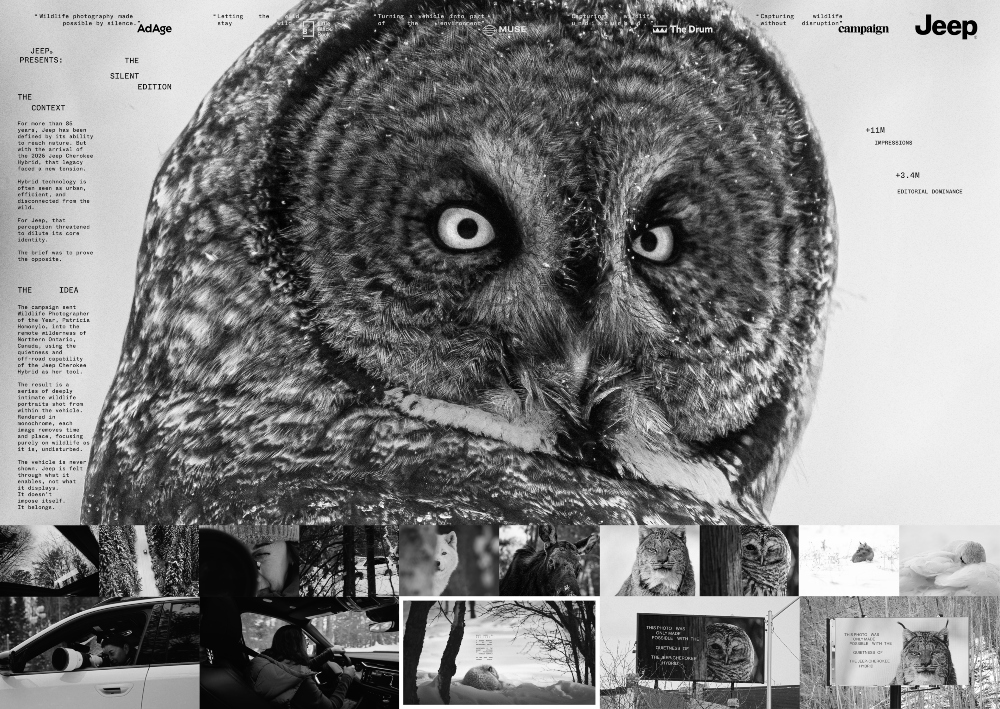
Publicis, meanwhile, picked up a Silver Lion for Jeep’s “Silent Edition,” which turned the Jeep Cherokee Hybrid’s near-silent operation into proof of performance by capturing wildlife behaving naturally and undisturbed.
Beyond Canada’s wins, one of the clearest themes to emerge from this year’s Print & Publishing jury was the power of radical simplicity. In an interview with strategy, Jessica Apellaniz, CCO at Wieden+Kennedy Mexico and jury president for Print & Publishing, said many of the strongest campaigns stripped away products, logos and explanatory copy, relying instead on the bare minimum of brand cues.
In doing so, they tested the strength of a brand’s equity, revealing which companies had built identities powerful enough to be recognized without their usual assets.
According to Apellaniz, the strongest entries trusted audiences to make the connection without over-explaining the idea, demonstrating the long-term value of consistency and distinctive brand assets. At the same time, the jury was careful not to reward simplicity for its own sake. Some campaigns, while visually striking, depended too heavily on case-study videos to explain themselves.
Strategy: What role does print continue to play in award-winning creativity despite the industry’s digital focus?
Bronstorph: For me, print is still the ultimate medium for advertising. It demands absolute purity of thought. When you get print right, it is a joy to look at. Because to be able to distill an idea to its core with one key visual is a really special talent. And I think anyone working in advertising today would agree that it is not the legacy medium it was made out to be when digital first arrived. It is the definitive proof of a great idea.
What separated the strongest Printing & Publishing work from the rest of the field?
Our jury president gave us three words before we began judging: fast, fresh and memorable. The ones who rose above were easily and quickly understood, had masterful craft, a fresh take on a human insight, and something you’ll still be referencing years from now.
How are brands and publishers rethinking the medium to stay relevant in today’s media landscape?
The beauty of print is that they are not. You still see people trying to get to the absolute heart of the idea and put it on a page.
Looking across this year’s winners, what’s one thing the global creative industry understands today that Canada should be paying closer attention to?
I actually think Canada has had a very strong showing so far. In my category alone, we saw a Silver Lion and a Grand Prix from Canada, so it’s wonderful to see us lead the industry and set the bar for what amazing creative can be in a classic medium like print. We talked a lot about simplicity and craft, and how a strong idea and insight should be able to cross cultures and countries, resonating far and wide.